Showing posts with label Socializing. Show all posts

Wednesday, January 10, 2018

Available puppy!


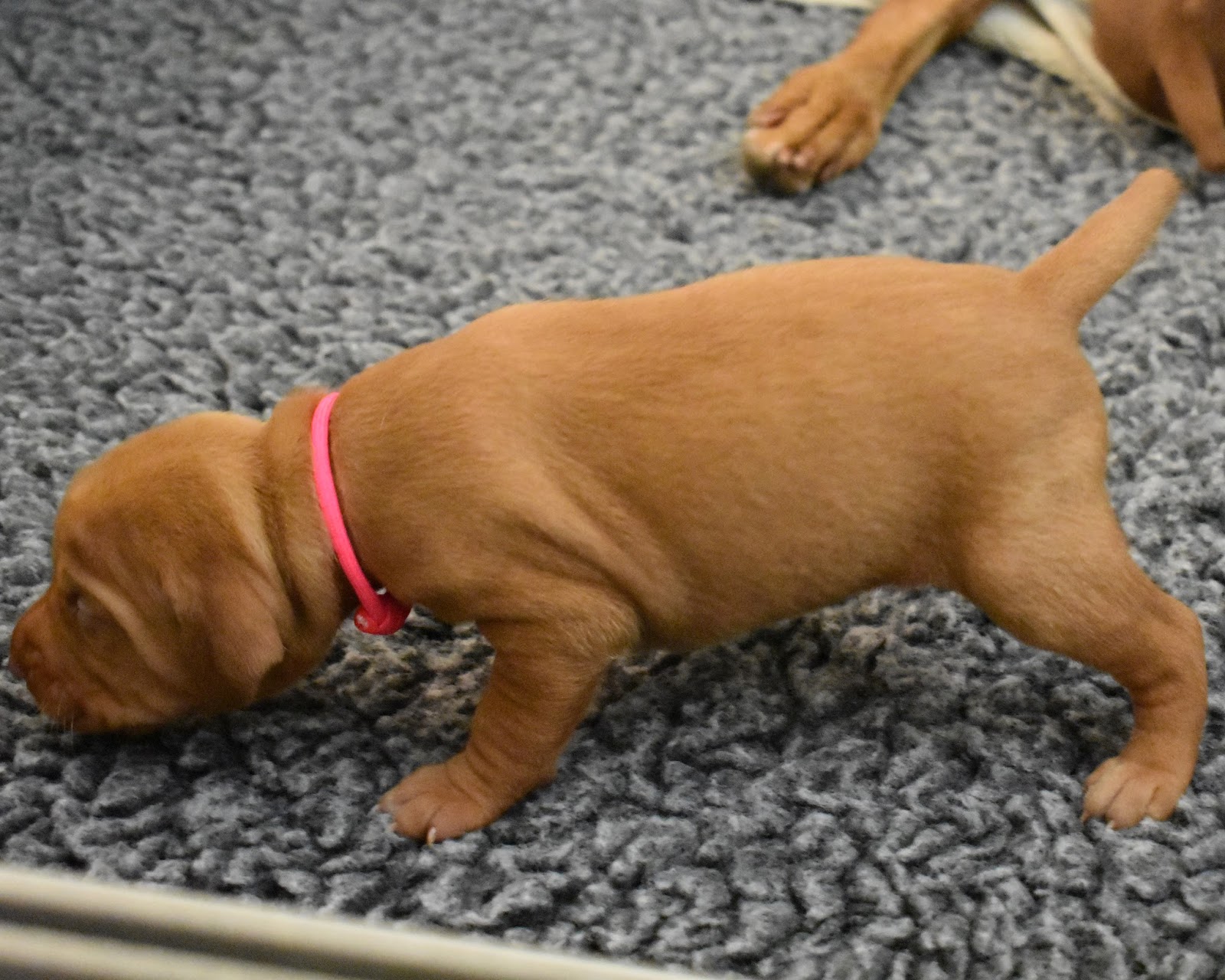
Due to several time-wasters -- I am pleased to share that beautiful "Gerdie" (Coral Girl) is available for adoption to a home in Southern California!

Gerdie is started on potty training and crate training and has been extensively socialized, she also has her first shots.

Please fill out the contact form on my website, or send an appropriate intro email to karen@moonlightvizslas.com

Sunday, December 24, 2017

The Goodies we're 8 weeks old!


The Goodies’ last group photo before they join their forever homes. Hard to believe they’re already eight weeks old. What a fun bunch of puppies, I’m going to miss each and every one — but they have some fabulous homes waiting...stay tuned!

Thursday, December 21, 2017

Thoughts on puppy raising . . .

The hardest part of raising a puppy is not to stifle them. Yet we must be there to protect them every step of the way. Finding that balance, between freedom and protection, is a difficult one to find. We want to tend to their every need, and cuddle away every whimper, and when we do, we stunt their emotional growth. We keep the fearful ones fearful, and the bold ones simply find us irritating.

Our puppies must learn to problem solve, and work out their own difficulties. Our job is to find the balance of when to help them, when to give them a kiss and a nurturing shove forward to work it out on their own, to know when to laugh at them for the dumb error that they just committed, when to force them to succeed and then reward them as though it was their own brilliant idea, and when to simply protect them and keep them safe.

When raising a puppy, I use what they offer to build their confidence. My past two weeks have been spent with two wonderful baby boys. Both are needing help dealing with big adult dogs at the park. Both pretend to act over confident and 'cool' when they really would rather climb inside my jacket and be carried! Growing up is scary, and my understanding and help, and hand-holding, has given them the courage to act like stellar lads.

My first little man had a fabulous temperament, and fabulous raising thus far, so he only needed teasing reminders such as "Grab your Ball" when passing a dog. By keeping his mind on the soother in his mouth, his manners were spectacular, and he had the confidence to move on past temptation.

My second little puppy could not have been more different. He had no social skills, and only confidence through his teeth, so pretended he was the biggest and toughest dog in the world. He needed to be carried past dogs and see them from the safety of arms. Then he needed to be on the ground, with hands guiding him, reminding him that is was me and him against the world. Now we are at the stage of going past the dog, and throwing a cookie in the direction that I want him to go (straight past). I am giving him a reason to leave the encounter. I'm not forcing him. It is his choice to leave (so he keeps all his power). I've just presented a darned good reason why he should leave. This little man has given me his heart and soul. He tries hard to please - but he has no idea how to behave. It is my job to show him how. Because of all that he has missed, he is never going to be the role model at the dog park. But he can learn manners, and how to be a well adjusted, confident adult, by being schooled on what is wanted, and by watching my well behaved adult dogs demo for him.

We are repeatedly told that dog training is science. I disagree. I think it is more like art. Each dog is a blank canvas, and it is up to us to create our perfect dog. We are given a topic, and then the creation is left in our own hands.

There certainly is a scientific component to it; If you do this - you will get that. But first you must envision your canvas so that you know what you want to create, and then you use your science to help you get it.

This is the reason that if you present one problem to ten dog-trainers, you will get ten answers. All might be right, but each trainer will create a very different canvas, depending upon what they saw.

Monique Anstee
Victoria, BC
www.naughtydogge.com

Dr. Jean Dodds Vaccination Protocol

Reminder . . .

2016 DODDS VACCINATION PROTOCOL FOR DOGS

The following vaccine protocol is offered for those dogs where minimal vaccinations are advisable or desirable. The schedule is one I recommend and should not be interpreted to mean that other protocols recommended by a veterinarian would be less satisfactory. It’s a matter of professional judgment and choice.

9 - 10 weeks of age
  • Distemper + Parvovirus, MLV
  • e.g. Merck Nobivac (Intervet Progard) Puppy DPV

14 – 15 weeks of age
  • Distemper + Parvovirus, MLV
18 weeks of age
  • Parvovirus only, MLV
Note: New research states that last puppy parvovirus vaccine should be at 18 weeks old.

20 weeks or older, if allowable by law
  • Rabies – give 3-4 weeks apart from other vaccines
  • Mercury-free (thimerosol-free, TF)
1 year old
  • Distemper + Parvovirus, MLV
  • This is an optional booster or titer. If the client intends not to booster after this optional booster or intends to retest titers in another three years, this optional booster at puberty is wise.

1 year old
  • Rabies – give 3-4 weeks apart from other vaccines
  • 3-year product if allowable by law; mercury-free (TF)
Perform vaccine antibody titers for distemper and parvovirus every three years thereafter, or more often, if desired. Vaccinate for rabies virus according to the law, except where circumstances indicate that a written waiver needs to be obtained from the primary care veterinarian. In that case, a rabies antibody titer can also be performed to accompany the waiver request. Visit The Rabies Challenge Fund for more information.

W. Jean Dodds, DVM
Hemopet / NutriScan
11561 Salinaz Avenue
Garden Grove, CA 92843

Source: http://drjeandoddspethealthresource.tumblr.com/post/147595920886/dodds-vaccination-protocol-dogs-2016#.WCtW_KIrKu4

Friday, December 15, 2017

The Damaging Effects of Spaying and Neutering on Dogs

Story at-a-glance . . .
  • A new study of German Shepherd Dogs adds to a growing body of research on the damaging effects of spaying and neutering on dogs
  • Earlier studies on other breeds, including Rottweilers, Golden Retrievers, and Vizslas, suggest that desexing can dramatically increase the risk for serious diseases and behavioral disorders in these dogs
  • When dealing with 100 percent responsible pet owners, my preference is to leave dogs intact whenever possible to avoid unnecessary risks of anesthesia. When pets must undergo a sterilization procedure, I advocate an alternative procedure to a full spay or neuter that spares the gonads and ovaries, which produce hormones essential to good health
  • Ovary sparing spays are equally as effective as traditional spays at preventing unwanted litters, but they are less invasive and eliminate the risk of endocrine damage
  • Veterinary schools need to teach less damaging sterilization methods to students, as research shows our current surgical approach to controlling unwanted pregnancies can permanently affect dogs in negative ways. In addition, the surgical technique used by high volume spay clinics and shelters to sterilize very young dogs could easily be updated to a less damaging technique, while still accomplishing the goal of preventing unwanted litters
Read the entire link:  https://healthypets.mercola.com/sites/healthypets/archive/2016/07/27/neutering-spaying-effects.aspx?utm_source=facebook.com&utm_medium=referral&utm_content=facebookpets_ranart&utm_campaign=20170617_neutering-spaying-effects

Saturday, December 2, 2017

Puppy Nipping -- this comes up with *every* puppy


Have you checked out Puppy Culture?


Puppy Culture is a guiding hand for you and your puppy.

Our team of experts have bred, raised, and trained thousands of dogs, and we know from first hand experience what works best. We make that vast experience available to you, broken down into clear instructions, in short chapters that are easy and fun to watch. 

How you teach your puppy is as important as what you teach your puppy.

Studies have shown that many common training techniques can actually increase aggression and problem behaviors, which can damage the human-animal bond. The Puppy Culture program will show you how to train your dog while enriching your bond with him, every step of the way.  

Real life proof that it works.

Most puppy training videos appear to have been shot in one weekend, using a few easy-to-train puppies. How do you know those training techniques really work in the long run? Unlike other films, Puppy Culture tracks one litter over three years, so you can see the true results of our program. You’ll see the puppies overcome real and varied behavior challenges and ultimately grow to gentle, well-behaved adult dogs.

The truth about socialization.

During this sensitive time, the puppy is as vulnerable to imprinting negative experiences as he is to imprinting good experiences. This means you need a good plan for socializing your puppy.  Your Puppy Culture team gives you a plan and guides you through the process.

How to be your puppy's advocate.

It can be difficult to stand up to a person in a position of authority, such as a veterinarian or a dog trainer, but you need to learn what’s right and wrong for your puppy, and stand up against bad advice.  Puppy Culture’s veterinarians, behaviorists, and breeders give you the facts to know when you’re right, and the conviction to walk away from anything that might harm your puppy.

Tuesday, November 28, 2017

Father & son -- Teak & Tanner


Cute photo from Teak's owner Mary of the 💙 boys, father & son -- Tanner & Teak (grey on his muzzle)

Sunday, November 26, 2017

Flashback to 2016


Sharing a cute photo of Zene with her 2016 Litter -- Three generations sharing a bed!

Sunday, November 12, 2017

Puppy kisses! 💋

We had a fun time getting mug shots of the pups tonight -- who doesn't love puppy kisses? 💋


We've got eyeballs 👀 and we're mobile!

The Goodies are two weeks old and their eyes are starting to open, some are opening sooner than others which is completely normal. They are also more mobile and starting to vocalize, this will only increase over the next week(s).

Bitey face - puppies explore the world with their mouths

Georgie tasting Granger

Granger and Garth (behind)

Garth

Greer is mobile


Friday, November 3, 2017

Our first pawticure 💅🏼

Vizslas are a relatively easy (wash and wear) breed, and the only regular grooming needed is nails and teeth. NAILS SHOULD BE DONE WEEKLY.

Puppy toenails are first trimmed at a few days old (with child's nail clippers), and every 3 days thereafter. You would not believe how long the nails get and if left untrimmed they can scratch one another in the eye or tear up mom's nipples and teats.

You can see how sharp/long they are only after a few days old - wow!

"Granger" getting ready for his first nail trim!

At two+ weeks old the puppies will be started on the dremel (on low speed). It is so much faster and easier than clipping! I use a cordless version for pups and adults, $40+ on amazon.com, link to buy:


Pups will be acclimated to the dremel by the time they go home and the owner is required on puppy "Go Home Day" to demonstrate their ability to trim the nails (and bring their dremel!). This is a weekly requirement for each Moonlight Vizsla Puppy owner 👍🏻

 "Zene" and her "perfect pedi"

Even seniors need nail care! This Granny "Csilla" who is 12 1/2 and gets the dremel weekly

NOTE:  If you can hear your dog's nails on the floor, they are already too long!

Wednesday, November 1, 2017

The Goodies start ENS today


We have been performing Early Neurological Stimulation, otherwise called E.N.S. or the Bio Sensor / “Super Dog” Program since 2009. Once the work of the military, noted breeder, author, lecturer and researcher, Dr. Carmen Battaglia is the main driving force behind why many breeders now know of this program.

We also incorporate Jane Lindquist’s “Puppy Culture” socialization methods as a preliminary training for all our puppies.

Both programs help allow our puppies to get off to a better start in life through sound desensitization, socialization, clicker conditioning, and much more. The goal in adding these programs to our breeding protocol is to help condition your new puppy to have better startle recovery, be curious rather than unsure of new objects as well as people, teach them how to learn so that training is smoother and to allow for an overall easier transition to their new life with you. 

Early Neurological Stimulation

As previous scientific research has proven, early stimulation exercises can have positive impacts long-term on a variety of species. While there is no specific amount of time that is stated to be optimal, some amounts can be too much and cause pathological adversities. The military began this early stimulation program and saw important, lasting results with their dogs.

With Early Neurological Stimulation (hereafter ENS), exercises begin at day three of life until day sixteen as this interval of time is believed to be a time of rapid neurological development and growth. There are five exercises which are conducted on each individual puppy for 3 – 5 seconds each. 

Head held erect
Head pointed down
Tactile stimulation
Supine position
Thermal stimulation

These exercises produce neurological stimulation that would not occur naturally until much later in their lives. They do not get repeated more than once a day, so we do not overload the puppy.

Dogs that received ENS as puppies had:
Stronger adrenal glands
Higher tolerance of stress
Greater resistance to disease
Stronger heart beats
Improved cardio vascular performance

To learn more about ENS, read Dr. Carmen Battaglia’s article on his website here.

Also check out this clip from Puppy Culture to see how the different ENS exercises are performed.

Saturday, October 21, 2017

Make Your Life Easier -- start training from DAY ONE

Every puppy comes to their new home with an inherent desire to follow. They are always underfoot and look to you for guidance and entertainment. Then something happens...they turn 16 weeks and realize that they can be independent. 

If you do it right, teaching your new puppy to come back when called is the easiest skill to solidify. Your puppy is already showing you the desired behaviour. All you need to do is reward it, praise it, solidify it. By rewarding their desire to follow, you are creating a solid foundation on which to build your recall. If you wait until they are 16 weeks old, you will have to work exponentially harder to make recalls fun and rewarding. 

Make life easier for you and your new pup - start training from day one and always reward the behaviors you like.

Erinn Lee Dog Training

And then there were NONE!

Baby Gigi (Purple Girl) stayed at Moonlight Vizslas and became "Emery" and she's exceeded my expectations in every way ....